Documents and data
Diagram, visual canvas, or presentation: how to choose the right format to document a process
A practical guide to deciding when to use a diagram, a visual canvas, or a presentation when documenting processes, while keeping originals, versions, and exports under control in Apification.

The problem: not every process needs the same file
Choosing a format to document a process can seem like a minor decision until the team tries to review it, present it, or execute it. A diagram that is too rigid can block an exploratory conversation; a visual canvas may be clear to the person who created it but difficult to turn into operational instructions; and a presentation may work in a meeting but become an awkward repository if it is filled with details, tables, screenshots, and exceptions.
The key is to separate three needs that are often mixed together: thinking through the process, operating the process, and communicating the process. Thinking requires flexibility; operating requires structure and traceability; communicating requires narrative, synthesis, and rhythm. Apification Cloud helps keep those pieces in the same organized, versioned space, ready to share files, editable services, and generated results without losing the relationship between the original, the export, and the history.
- Do not document an exploration as if it were already a standard.
- Do not turn a presentation into a database of instructions.
- Do not publish a final image if you do not keep the editable file.

Three questions before creating anything
Before opening a tool, ask three questions. The first is: what is needed right now: to explore, approve, execute, or present? If the process is still under discussion, a flexible visual space is best. If it will already be used by people who must repeat it, an editable document or a structured outline is best. If the goal is alignment in a meeting, a presentation with a clear sequence is best.
The second question is who will maintain the material afterward. If there will be frequent changes, the source format should live in Cloud and not in a personal folder. The third is what deliverable each audience needs. A client may need a PDF or an exported image; an internal team may need the corresponding editable file. In Apification, the detected type, subtype, and extension determine the preview, editor, transformations, and available download formats, so it is best to choose from the start a format that is consistent with later use.
- Explore: prioritize freedom and quick review.
- Approve: prioritize clear reading and controlled versions.
- Execute: prioritize updatable instructions.
- Present: prioritize narrative and synthesis.

When a diagram or visual outline is best
A diagram is the best choice when the value lies in understanding relationships: steps, decisions, dependencies, branches, inputs, and outputs. A diagram prioritizes shapes, connectors, and visible structures, so it fits well with flows, approvals, and processes built with elements that show how one action leads to another.
The common mistake is exporting the diagram to an image or PDF, sending it as if it were the source, and forgetting the editable file. That prevents changing a decision, correcting a label, or reorganizing a flow without rebuilding it. The operational rule should be simple: keep the editable original in Cloud and generate exports as separate deliverables. The export is for reading and distribution; the editable file is for maintenance.
- Use it if there are yes/no decisions, approvals, or dependencies.
- Use it if several areas need to see where their work enters and leaves.
- Avoid it if you need to write long policies or explain arguments in depth.
When a visual canvas is best
A visual canvas is best when the process needs to be explained through composition: images, short text, shapes, visual hierarchies, or design variations. Apification Image Studio lets you work on an integrated canvas with layers, text, shapes, filters, and modern formats. It also lets you configure the width, height, orientation, background, and transparency of the composition, which is useful when the result needs to fit a specific asset.
The advantage of the canvas is its ability to organize visual ideas without forcing them into a linear sequence. The disadvantage is that it can become ambiguous if it is used as a substitute for a procedure. To reduce that risk, name layers, reorder them intentionally, and lock or hide elements when needed. Image Studio lets you add, rename, reorder, hide, and lock layers without modifying the sources. Also remember the difference between saving and exporting: saving preserves the project; exporting creates an image that can be downloaded, saved, transformed, or shared in Cloud.
- Use it for visual maps, training assets, and graphic explanations.
- Separate elements into layers to make later changes easier.
- Do not use it as the only place to store extensive operational rules.
When a presentation is best
A presentation is appropriate when the process must be told in a sequence: context, problem, proposal, main steps, risks, and expected decision. It also works for training, phased approval, or client meetings. In Apification Documents you can create and edit office files with ONLYOFFICE without leaving Apification, keeping them inside Cloud storage together with other project files.
The problem appears when slides become the only repository for detail. A presentation should show what is necessary to decide or learn, not absorb every procedure, table, and appendix. If long documentation is required, create or maintain an editable text document and link it organizationally in Cloud alongside the presentation. Apification Documents works with ONLYOFFICE-compatible office files, and the updated file can be kept inside Cloud to preserve continuity and version history.
- Use it if you need to guide a conversation or training session.
- Keep each slide focused on one idea or decision.
- Store operational detail in editable documents, not in scattered notes.
Common mistakes and warning signs
The first warning sign is finding pasted screenshots without an editable source. A screenshot can help illustrate, but it should not replace the file that makes it possible to update the process. The second is seeing names like final, final_final, or approved_new. They usually indicate that the team does not trust the history or does not know how to restore previous versions. In Apification Cloud, properties, versions, permissions, groups, and the recycle bin remain linked to the item, making it possible to work continuously without multiplying unnecessary copies.
The third sign is mixing originals and exports in the same folder without a clear rule. A reading PDF, an exported image, and an editable project do not serve the same function. If someone edits the PDF thinking it is the original, the process becomes fragmented. Create a clear convention: a folder for editable sources, a folder for deliverables, names with a date or status when useful, and someone responsible for maintenance. That way, everyone knows whether they should review, present, execute, or archive.
- Screenshot without source: risk of redoing work.
- Slide with excessive detail: risk of poor execution.
- Export without original: risk of being blocked when changes are needed.
- Multiple final copies: risk of reviewing the wrong version.
Recommended workflow in Apification Cloud
A practical workflow starts by saving originals in Cloud. You can upload files by drag and drop, use common Cloud selectors, or import from connected external providers. Within the same space, you can keep files, folders, editable services, and generated results. This continuity matters because a process rarely lives in a single piece: it may have an operational document, a visual outline, a presentation for approval, and an exported image for training.
Next, choose the tool according to its function. For editable documents, spreadsheets, and presentations, use Apification Documents with ONLYOFFICE. For outlines, processes, and technical structures, keep the corresponding editable file and organize its deliverables in Cloud. For supporting visual resources, use Image Studio with canvas, layers, text, and shapes. When you need to distribute, generate separate exports. Apification enables transformations and download formats when available; it is best to treat those outputs as deliverables, not as substitutes for the original.
- 1. Create or upload the source file in the correct folder.
- 2. Edit the right format according to the objective.
- 3. Save the editable original as the main item.
- 4. Generate exports for reading, training, or delivery.
- 5. Review the history before creating parallel copies.
How to share for review without losing operational control
Review should fit the use case. In Apification, resources are private by default and can be shared with users or groups without necessarily changing their public visibility. It is also possible to share items through links, users, or groups and provide downloads of the original or a transformed version. This makes it possible, for example, to send a readable export to a client while keeping the editable project for the internal team.
It is important not to confuse sharing with absolute legal control over what has been downloaded. Once someone downloads a file, you should not assume capabilities that are not part of the permitted flow. The safe practice is to decide what is being delivered: an editable original for collaborators who need to modify it, a transformed version for review or reading, and a link or group access according to the audience. If a change goes wrong, use the Cloud item history to review previous versions, download an earlier version, or restore content safely instead of creating new final_final copies.
- Share by user or group when the review is internal and recurring.
- Share by link when the recipient needs one-off access, depending on the available configuration.
- Deliver exports when you do not want the recipient to work on the source.
- Keep the editable original in Cloud and document who maintains it.
Frequently asked questions
What is the safest way to choose a format to document a process?
Start with the main use: exploration, execution, approval, or presentation. Use diagrams for relationships and decisions, editable documents for operational instructions, visual canvases for explanatory compositions, and presentations for meeting or training narratives.
Can I use a presentation as an operational document?
It can serve as support, but it is not usually the best repository for detail. If the process contains rules, exceptions, or long instructions, it is best to keep an editable document in Cloud and use the presentation as a narrative summary.
Why is exporting a diagram to an image or PDF not enough?
Because a visual export does not necessarily preserve the editable source. To be able to correct, update, or reorganize the material later, save the editable original in Cloud and treat the export as a reading or distribution deliverable.
How do I avoid versions like final_final?
Keep the file updated in the same Cloud item and use version history. Apification lets you review the item history, download previous versions, and restore content safely.
What should I review before publishing a process?
Check that there is an editable source, that the export is readable, that the names distinguish between original and deliverable, that permissions or links are appropriate, and that someone is responsible for maintenance.
Sources and further reading
Documentation consulted while preparing this article.
- Cloud de Apification — Apification
- Image Studio — Apification
- ONLYOFFICE Document Editor — Version history — ONLYOFFICE Help Center
- ONLYOFFICE Presentation Editor — Version history — ONLYOFFICE Help Center
- ONLYOFFICE Presentation Editor — Commenting presentations — ONLYOFFICE Help Center
Explore Apification
Related articles
Documents and data
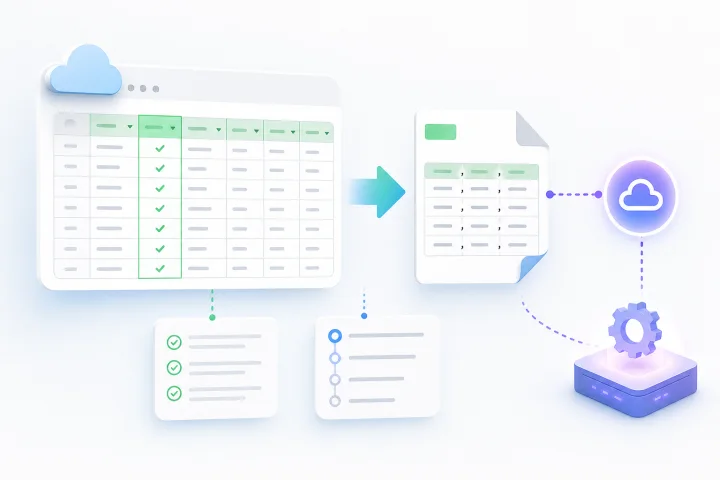
Export spreadsheets to CSV for integrations: separators, dates, and fields that must not break
A practical guide to preparing an editable sheet, converting it into a CSV consumable by external systems, and retaining control over versions, testing, and delivery.
Documents and data
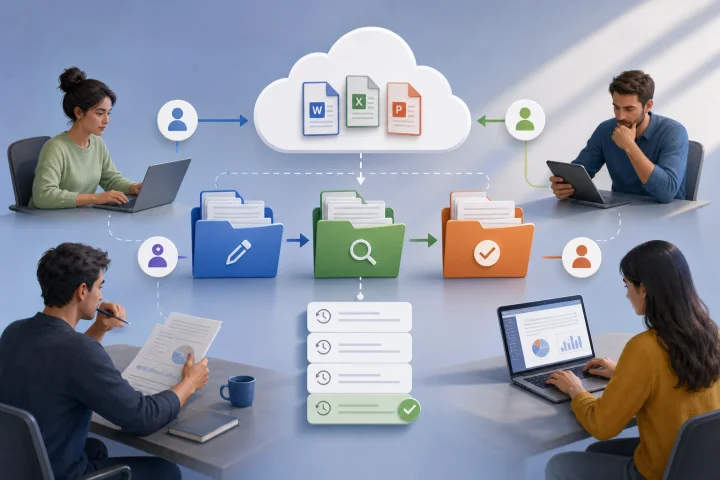
Editing Office documents in the cloud without duplicates: a workflow with history and controlled delivery
A practical guide for teams that review editable documents without multiplying copies, using Cloud work, permissions, history, and controlled delivery.

Documents and data
Clear and accessible downloadable documents: how to prepare them before sharing
A practical guide to publishing downloadable documents that are easy to understand, reasonably sized, preserve context, and avoid version confusion.