Files and formats
Transformed file downloads: deliver variants without duplicating the original
A practical guide to using transformed file downloads in Apification Cloud, separating the master from its derivatives, and deciding when to save an export of its own.

The problem: too many copies for the same content
Transformed file downloads solve a very common problem for content, training, marketing, support, and operations teams: the same document starts as a master file, is exported to PDF, then to an image for the web, then to a compressed version or a trimmed video, and after a few weeks nobody knows which copy is current. The folder ends up full of names like final, final2, approved, or send, with links still circulating even though the content has changed.
The operational cost is not only in the visual clutter. When the master file is mixed with delivery derivatives, it becomes harder to withdraw a variant, update it, explain its purpose, or know whether an external person received the editable original or a non-source delivery format. In Apification Cloud, uploaded files, folders, editable services, and generated results can be kept inside the same workspace, which makes it possible to treat the master and its derivatives within a unified library, but that advantage requires a clear rule: not every result should become an independent file.
- Main risk: losing the reference to the master file.
- Secondary risk: maintaining old links to variants that have already been superseded.
- Goal: deliver the right format without multiplying unnecessary copies.

Core concepts: master, version, transformation, and download
It is useful to separate five concepts. The original or master file is the source the team wants to keep as the main reference. A historical version is a previous state of that same resource; it is used to view, download, or restore earlier content, but it should not be used as a parallel folder of final exports. A transformation is an operation applied to a compatible file, for example converting, splitting, combining, optimizing, or processing documents, images, video, audio, or data through a guided assistant.
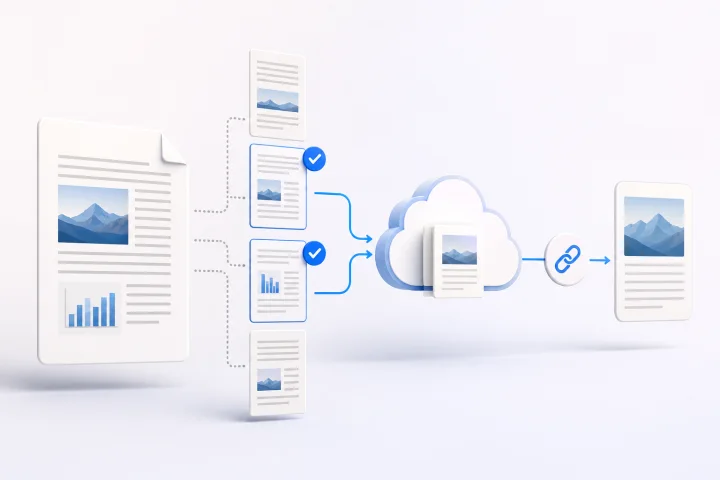
A saved export is different: the result is kept as its own resource in Cloud, private by default, and can be managed, versioned, downloaded, or shared. By contrast, a transformed download is a delivery generated from the share or download flow in a compatible format, without needing to create a permanent copy for every recipient. Apification determines the available operations from the detected type, subtype, and extension of the resource, so the actual options depend on the file and the selected action.
- Master: the main source that should not be overwritten by a conversion.
- Historical version: a recoverable previous state of the same resource.
- Saved export: a derivative with its own life inside Cloud.
- Transformed download: a delivery variant generated when needed.

When a transformed download is enough
A transformed download makes sense when the variant is only a format for consumption, review, or compatibility, not an asset with its own governance. Typical examples include a PDF for external review, an image optimized for the web, trimmed audio for listening to a fragment, rendered video for validating a proposal, or a document converted for reading. In these cases, keeping every output as an independent file can create more noise than value, especially if the master will continue to change.
In Apification, the sharing flow lets you deliver the source file or generate a download in a compatible format. This is useful when a client, student, or collaborator needs to receive something specific, but the internal team does not need to manage that variant for months. The practical decision is simple: if the variant can be regenerated from the master and does not require approval, manual editing, or explicit retention, it is usually enough to offer it as a transformed download from the sharing flow.
- Use a transformed download if the output is temporary or reproducible.
- Use it if the recipient does not need the source file.
- Use it if that variant will not have its own review process.
- Avoid it if the result will be a final contractual, editorial, or training deliverable.
When to save the derivative as a separate file
Saving a transformed result in Cloud is useful when the derivative stops being a simple conversion and becomes a deliverable. This happens with materials approved by a manager, manually edited assets, variants that require their own review process, resources that will be published for a specific period, or files that must be kept as operational evidence of what was delivered. In that case, the variant needs a name, permissions, history, and the option to restore it.
Apification’s File Transformer lets you generate the result and download it or save it in Cloud. When you choose to save it, the result becomes a private resource that can be managed, versioned, downloaded, or shared from Cloud, while the originals remain intact. This separation prevents overwriting the master and lets the derivative have its own lifecycle. The key criterion is to ask whether someone will need to find, audit, withdraw, or reuse that exact variant later.
- Save the derivative if it was approved as a final deliverable.
- Save it if it was manually edited after conversion.
- Save it if it needs its own permissions or review.
- Save it if it must be restorable as an independent resource.
Recommended workflow in Apification Cloud
A safe workflow starts by saving the original in Cloud and avoiding transforming it out of context. From there, the Transformer can be opened from Cloud, from Properties > Transform, or from Share > Download on a compatible file. If it is opened from a file, the type and subtype are fixed and the resource appears preselected, reducing the risk of applying an action to the wrong item. The assistant proposes valid operations for one or more Cloud files without modifying the originals.
The recommended operating procedure is to select the type and subtype, choose compatible files, select an action, configure parameters, generate the result, and download it or save it in Cloud. Depending on the action, the options may include format, quality, pages, dimensions, codecs, bitrate, sample rate, channels, times, OCR, metadata, protection, or watermarks. Before publishing or sending, it is useful to test the result with the real recipient in mind: open the file, check pages or duration, review readability, verify the generated name, and confirm whether the original or a transformed variant will be shared.
- 1. Save and locate the master in Cloud.
- 2. Open the transformation from the file itself when possible.
- 3. Configure only the parameters needed for the recipient.
- 4. Generate a test before sharing.
- 5. Decide between a transformed download or saving in Cloud.
- 6. Share by link, user, or group as appropriate.
Names, notes, and change control without chaos
Naming prevents a good policy from breaking down in practice. For saved derivatives, use suffixes for format and purpose: student-guide-reading.pdf, web-banner-1200.webp, support-audio-fragment.mp3, or demo-video-render.mp4. Add an approval date when relevant and avoid ambiguous words like final if the resource can change. In Apification, Generate and download uses the original name with date and time; if it is saved in Cloud, it is best to apply a convention that is understandable to the team and to anyone with access.
History should not be confused with a folder of exports. In Apification, versions, trash, and restoration are part of the resource lifecycle: they let you view saved versions, download earlier content, and restore a previous state when needed. Use this to protect work from accidental changes, not to store all final variants. If a variant needs its own traceability, save it as a separate file; if you only need to return to an earlier state of the master, use versions.
- Include the format: pdf, webp, mp4, mp3, or another clear suffix.
- Include the purpose: reading, review, web, approved, support.
- Include the date only when it marks approval or delivery.
- Document compatibility notes if the format may change appearance or playback.
Common mistakes and how to prevent them
The most dangerous mistake is overwriting the master with a conversion. The Transformer works without modifying the originals, but team discipline still matters: do not download a variant, edit it externally, and upload it again with the same name if that could hide the source. Another common error is resending old links without checking what they deliver. Because resources are private by default and can be shared with users or groups without making them public, it is best to review the recipient, permissions, and format before each distribution.
There are also technical and compatibility limits that must be accepted. The action catalog depends on the extension, number of files, compatible type, and installed dependencies; in addition, limits may apply for upload size, storage, memory, time, number of files, and process complexity. Do not promise perfect equivalence between formats, because document, image, audio, or video conversions may vary depending on parameters and available engines. And remember the ZIP case: Apification can generate compressed files when there are multiple results, such as pages, images, or segments, but ZIP is marked as generated only and is not supported as a direct upload or as a general transformation source.
- Check the source file before transforming.
- Do not mix tests and approved deliverables in the same naming convention.
- Review permissions before sending external links.
- Validate the result in the final format, not only the master.
- Do not treat a generated ZIP as if it could be uploaded and extracted inside the full flow.
Frequently asked questions
Does a transformed download modify the original file in Apification?
No. The File Transformer proposes valid operations for Cloud files without modifying the originals. The result can be downloaded or saved as its own resource.
When should I save a transformation in Cloud?
Save it when the derivative is an approved deliverable, needs its own review or permissions, has been manually edited, or must be explicitly retained.
Can I share the original and a transformed variant?
Yes. The sharing flow lets you deliver the source file or generate a download in a compatible format, and resources can be shared by links, users, or groups.
Does history replace a folder of final exports?
No. History is used to view saved versions, download earlier content, and restore previous states. Final deliverables should be saved as derivatives if they need their own life.
Can I upload a ZIP to extract or transform it in Apification?
Not as a general flow. Apification can generate ZIP files when a transformation produces multiple results, but ZIP is documented as generated only and not as a direct input.
Sources and further reading
Documentation consulted while preparing this article.
- Cloud de Apification — Apification
- Transformador de archivos — Apification
- Capacidades por formato — Apification
- REST API reference — Apification
- File API — W3C
- Portable Network Graphics specification index — W3C
- Tablas de los filtros de conversión de archivos — LibreOffice Help
- About Converting Microsoft Office Documents — LibreOffice Help
- Managing versions and revisions — ONLYOFFICE Help Center
- FFmpeg Filters Documentation — FFmpeg
Explore Apification
Related articles

Files and formats
Compress a PDF Without Losing Readability: Testing, Versions, and Controlled Delivery
A practical guide to reducing large PDFs without losing control of the original, with compression criteria, quality checks, and delivery from Apification Cloud.

Files and formats
Combine PDFs into a dossier: merge files without losing originals or traceability
A practical guide for teams that receive contracts, annexes, quotes, or evidence as separate PDFs and need to deliver a single ordered, reviewable, and shareable dossier without overwriting the originals.
Files and formats
Split a PDF before sharing: how to deliver only the necessary pages without losing traceability
A practical guide to extracting only the necessary pages from a PDF, preserving the original, validating the result, and sharing it with version control.