APIs and automation
Integrating a File API with OpenAPI: Contract, Tests, and Errors Before Automating
A practical guide to turning an OpenAPI specification into a verifiable flow when integrating files, transformations, and Cloud with REST, webhooks, iframe, and JavaScript.

Integration fails when the API is treated as isolated calls
Integrating an API with OpenAPI should not start by copying endpoints into an HTTP client and chaining responses until the flow “seems” to work. In a file integration, every call carries state with it: Cloud resources, folders, permissions, transformations, users, downloads, and events. If the team only tests the happy path, the first real failure usually appears when a file lacks permissions, a transformation returns a status other than the expected one, or an authenticated download is consumed from the wrong place.
The operational way to reduce that risk is to treat the API as a verifiable contract. In Apification, the REST reference is presented as an authenticated surface for accounts, Cloud resources, folders, transformations, users, and webhooks. In addition, the browsable reference is generated from the same OpenAPI 3.1 contract used for client generators and integration tests. That alignment matters: it lets documentation, client, and tests speak the same language before automation is expanded.
- Do not start by automating the entire process; first identify the minimum verifiable flow.
- Separate business state, technical state, and effective permissions from the design stage.
- Avoid treating a successful response as sufficient proof of the complete flow.

What OpenAPI provides when turning documentation into a contract
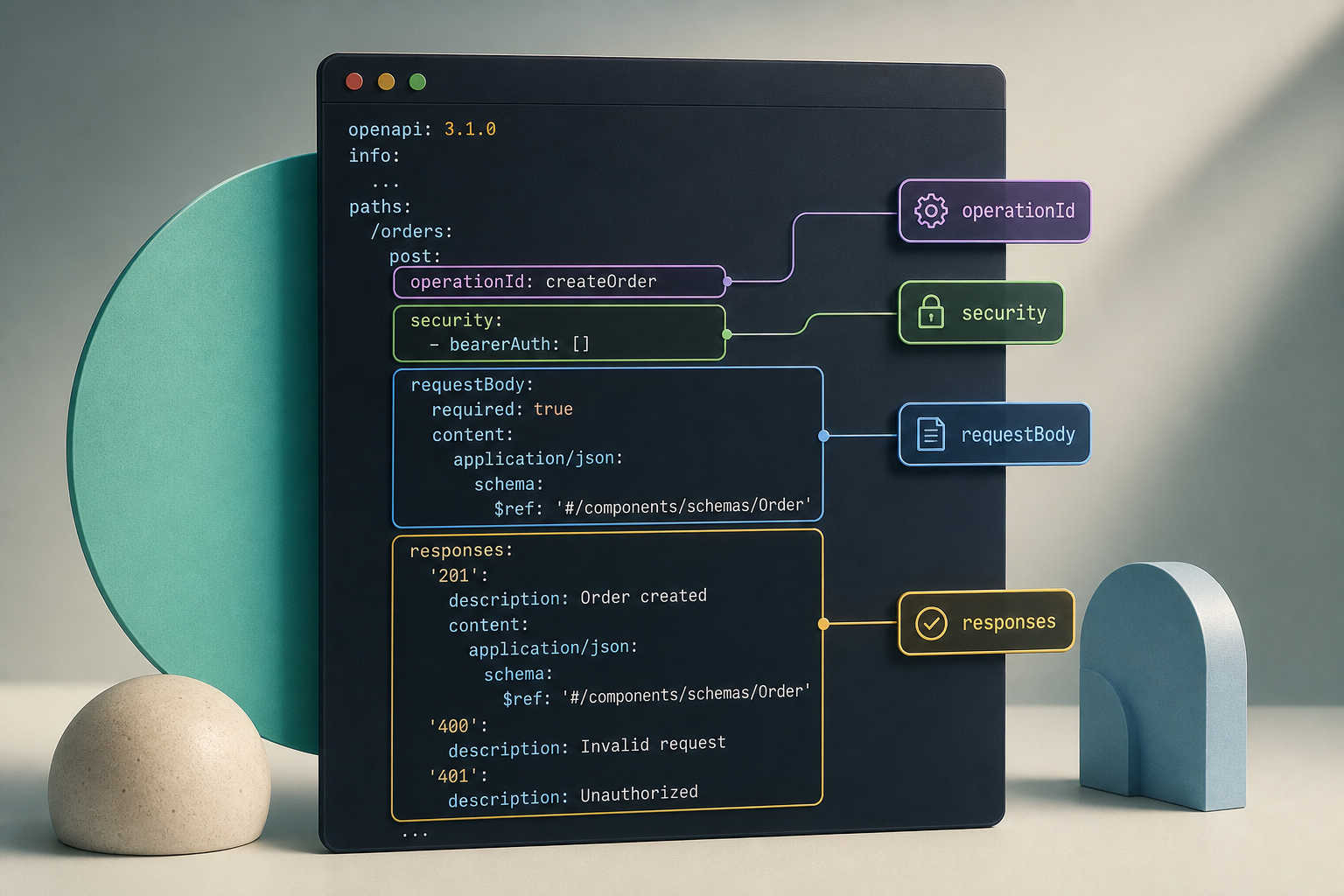
OpenAPI defines the paths object as the list of routes and operations available for an API. Each Operation Object describes an individual operation on a route and includes fields such as operationId, parameters, requestBody, responses, callbacks, deprecated, and security. For an integrator, this makes it possible to move from “there is an endpoint” to “this operation accepts this data, requires this security, returns these responses, and can change at these points.”
It is also worth reviewing security operation by operation. OpenAPI allows security mechanisms to be declared globally and per operation; when an operation defines its own security, it overrides the global security. In Apification, the downloadable OpenAPI 3.1 contract contains complete request and response schemas for starting API, transformation, webhook, and embedded integration flows. The engineering recommendation is to use that contract to select operations, generate or isolate clients, prepare tests, and detect changes before touching production.
- Review paths to define the real scope of the integration.
- Use operationId to map each operation to a clear function in the internal client.
- Validate requestBody and responses, not just status codes.
- Check global and per-operation security before assigning credentials.
Decision map: REST, webhooks, iframe, and JavaScript
Apification separates integration modes that solve different problems. The server-to-server REST API is used to manage Cloud resources, users, settings, and transformation jobs from the backend. It is the natural option when your system needs to create folders, upload files, query services, move resources, launch transformations, or download authenticated content. The reference documents, among others, operations for uploading files, downloading authenticated content, querying Cloud services, moving services, and managing folders.
Webhooks do not replace REST: they are used to react to relevant events without continuously polling every resource or job in the background. Apification associates them with HMAC-signed payloads, delivery history, retries, and transformation completion events. Embedded Cloud, by contrast, places the workspace inside the customer’s product through a controlled, branded session. That mode is linked to signed iframe sessions, themes, effective permissions, and JavaScript communication with the host. JavaScript should support the embedded experience, not safeguard secrets or decide permissions.
- Use REST when your backend must perform actions or query state under server control.
- Use webhooks when you need to react to events without continuous polling.
- Use an embedded iframe when the user needs to work inside a controlled Cloud workspace.
- Use JavaScript for interface communication with the host, not as an authorization layer.
Prepare the flow before writing code
Before generating a client or creating development tasks, describe the flow in terms of resources and decisions. For example: which file enters, which folder it remains in, which user or group is involved, which transformation is needed, which output will be downloaded, and which permissions each actor must have. Apification makes it possible to manage files, services, and digital projects in an organized, versioned workspace, share items through links, users, or groups, and provide original or transformed downloads. That functionality must be reflected in the integration design.
For transformation flows, the reference documents operations to list File Transformer operations, get the contract for an operation, validate and estimate before execution, create jobs, and query status, progress, usage, and results. This suggests a prudent sequence: discover the operation, validate input, estimate if applicable, create the job, wait for an event or query status, and finally obtain results. As a general recommendation, avoid mixing server credentials with user permissions: Apification recommends granting only the read and write permissions needed for the integration.
- List input resources: files, folders, users, groups, and services involved.
- Define outputs: original content, transformed content, queryable results, or authenticated downloads.
- Identify the minimum read and write permissions for each stage.
- Decide which states are queried through REST and which are received by webhook.
Design useful contract tests, not decorative ones
Contract tests should cover the minimum flow and its edges. OpenAPI defines responses as the list of possible responses returned when executing an operation; therefore, it is not enough to assert that the endpoint responds. For creation, reading, transformation, and download, validate that the expected fields exist, that types match the schema, and that unexpected responses are treated as unconfirmed states. If you generate a client from OpenAPI, still keep your own integration layer to translate errors and states into the language of your product.
A minimum set of tests should include upload or resource creation, resource reading, movement or placement in a folder if applicable, service or folder permissions, transformation with valid input, transformation with invalid input, authenticated download, and absence of permissions. Apification documents endpoints for Cloud service and folder permissions, which makes it possible to verify those cases explicitly. In webhooks, test signature, duplicate receipt, and retries from the perspective of your receiver; a webhook confirms a delivered event, not necessarily the entire functional state your application needs.
- Happy path: create resource, transform, receive event or query status, and download result.
- Permissions: authorized user, user without access, and server credential with minimum permissions.
- Invalid inputs: incorrect format, incomplete parameters, or non-applicable operation.
- Unexpected responses: missing fields, unknown status, or result not yet available.
- Webhooks: HMAC signature, retry, repeated delivery, and receiver idempotency.
Common errors and failure modes worth anticipating
The first common error is assuming that a webhook confirms the entire state. In reality, Apification webhooks make it possible to react to events and may include transformation completion, with HMAC signature, delivery history, and retries. Even so, your system must decide whether the event is enough or whether it needs to query the job, resource, or result through REST before moving forward. The second error is failing to make the receiver idempotent: if there are retries, processing the same delivery twice can duplicate internal actions.
The third error is storing credentials in the browser. In embedded integration, Apification distinguishes between backend and browser: provisioning, secrets, and session signing remain on trusted servers; the browser receives only the temporary context needed to render the embedded experience. In addition, embedded sessions use signed, time-limited access, and theme and effective permissions are resolved server-side before opening Cloud. Another frequent failure is mixing user permissions with server credentials or ignoring responses that do not fit the expected schema.
- Do not treat webhooks as the single source of truth if your flow requires checking a downloadable result.
- Do not store integration secrets in browser JavaScript.
- Do not reuse broad credentials when minimum permissions are enough.
- Do not accept out-of-contract responses without logging and classifying them.
- Do not expand automations without reviewing changes to operations, security, and models.
Change control and Apification’s practical fit
Safe change control starts by isolating the integration client. Instead of scattering REST calls throughout the product, create a module that centralizes authentication, operations, response validation, error translation, and logging of relevant requests. When the OpenAPI contract changes or new operations are added, review paths, Operation Objects, security, and responses before expanding automations. This is a general engineering recommendation, not a magic platform feature: the value lies in making the impact visible before deployment.
Apification fits that approach because it offers Cloud and its services through REST API, OpenAPI, webhooks, iframe, and JavaScript, with permissions and access controls according to the configured flow. REST covers backend automation; webhooks reduce continuous polling; iframe makes it possible to embed the workspace with signed sessions, theme, and effective permissions; JavaScript facilitates communication with the host. The right decision is not to choose a single channel, but to assign each responsibility to the appropriate channel and test the contract that connects them.
- Centralize the API client and avoid scattered calls from multiple modules.
- Log relevant operations, contract errors, and unrecognized responses.
- Review the OpenAPI specification before adding new automated flows.
- Maintain minimum permissions and embedded sessions signed from a trusted backend.
- Document which part of the flow depends on REST, webhook, iframe, or JavaScript.
Frequently asked questions
Does OpenAPI replace integration tests?
No. OpenAPI describes routes, operations, security, bodies, and expected responses. Tests verify that your client uses that contract correctly, handles errors, and does not assume states the API has not confirmed.
When should REST be used in Apification?
When the backend must manage Cloud resources, users, settings, folders, authenticated downloads, or transformation jobs. REST is the right channel for server-controlled actions.
Is a webhook enough to know that a transformation finished successfully?
It can notify you about relevant events, including transformation completion, but your application must decide whether it needs to query the job, resource, or result through REST before continuing.
What should not be done in an embedded integration?
Secrets or session signing must not be placed in the browser. In the approach documented by Apification, provisioning, secrets, and signing remain on trusted servers.
Sources and further reading
Documentation consulted while preparing this article.
- Apification REST API reference — Apification
- Apification product integration — Apification
- Apification automation and webhooks — Apification
- Apification reseller integration — Apification
- OpenAPI Specification v3.1.0 — OpenAPI Initiative
- RFC 9110: HTTP Semantics — RFC Editor / IETF
- OWASP API Security Top 10 2023 — OWASP
- MDN Same-origin policy — MDN Web Docs
- Pact documentation: introduction — Pact Foundation
Explore Apification
Related articles

APIs and automation
Reconciling webhooks and APIs in file flows: recover states without duplicating actions
Operational guide to reconstructing the real state of files, folders, transformations, and links when webhooks arrive late, are retried, or the consumer has been down.

APIs and automation
Automating file transformations with APIs: from a guided wizard to a verifiable flow
A practical guide to turning manual file conversion, optimization, or processing tasks into a repeatable flow with Cloud, OpenAPI, permissions, and signed webhooks, without assuming undocumented transformation endpoints.

APIs and automation
Safe retries in a file API: avoid duplicates
A practical guide to retrying outbound calls to Apification Cloud without duplicating folders, files, transformations, or shared links.